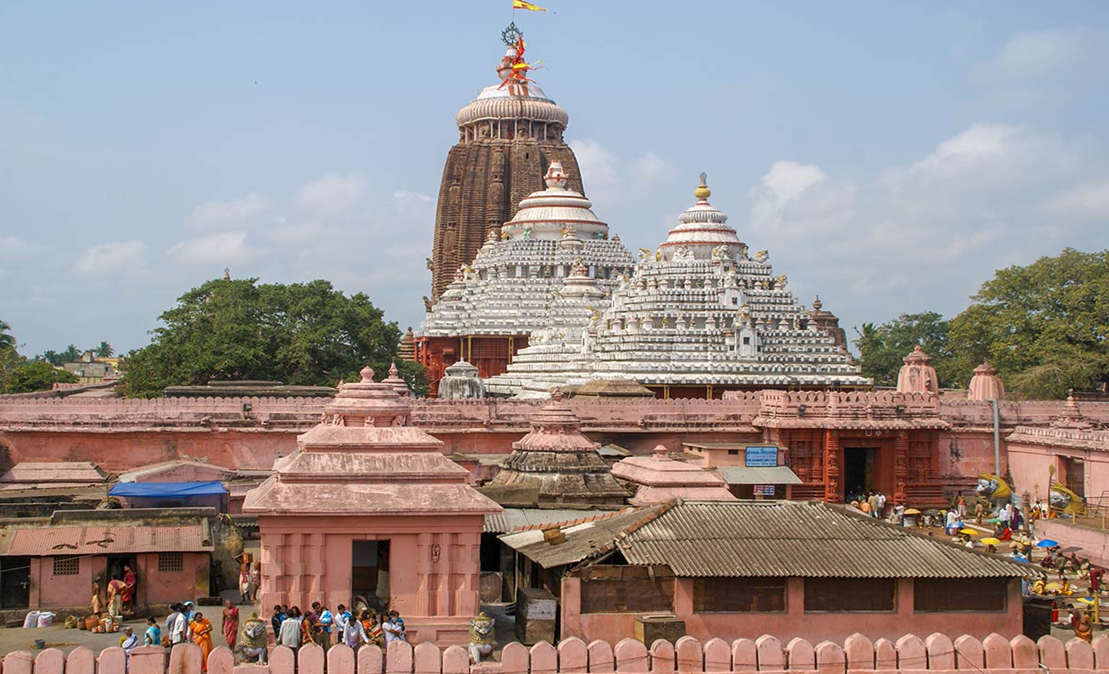
Day-1: Arrive Bhubneshwar - Local visit
Upon arrival at Bhubaneswar Airoprt/ Rly. Stn. Transfer to hotel. Bhubaneswar Known as the “Temple City”, founded during the Kalinga Empire over 3,000 years ago, Bhubaneswar today boasts of a cluster of magnificent temples, which once boasted of more than 2000 temples. Still preserves over 500 of India's finest temples. If time permits visit Lingaraj Temple Constructed in 650 A.D. this temple is a unique specimen of Oriyan style of architecture. The most special feature of this temple is the presence of one thousand lingas in the north-west corner of the complex. Dedicated to Lord Shiva as the name suggests, the temple was built sometime in the 7th century by the King Jajati Keshari. The Lingraj Temple houses a Shivalingam that rises to a massive height of 8 inches above the floor level and is about 8 feet in diameter as well. Lingaraj Temple is a spectacular specimen of Orissa style of temples with a hint of Kalinga style of architecture, covering a vast area of 2,50,000 sq ft., stand tall 180 ft.As many as 150 smaller shrines dot the temple complex. Non Hindus are not allowed inside the temple. Then visit Rajarani temple A popular 11th-century the Raja Rani Temple is locally known as the 'love temple' because it contains some sensuous carvings of women and couples. No images can be found inside the sanctum, and hence the temple is not associated with any particular sect of Hinduism. This is perhaps exactly where the charm of the temple comes from: the temple belongs to no specific sect and is open to all people irrespective of the deity that they worship and admire. However, the figures of Lord Shiva and Goddess Parvati carved on the walls strongly indicate that the temple has certain associations with Shaivism. Brahmeshwar Temple was built during 11th century A.D in honor of the presiding deity Brahmeshwar, who is a form of Lord Shiva. The 60-feet tall temple was the first to exhibit iron beams in construction and splendid iconography of dancers and musicians on the walls. The porch features carved ceiling with lotus, while the walls have motifs of lion head in abundance. Mukteshwar Temple is one of the most compact and smallest temples in Bhubaneswar, but is renowned for its imposing ceiling that is adorned with eight-petal lotus in the porch, and astounding stone archway. It was for the first time that carved images appeared in temple architecture, exhibiting beautiful lion-head motifs. “Mukteshwar” means “Lord who gives freedom through Yoga.” Parshurameswar temple the small but luxuriantly designed temple was built during 7th century and is one of the oldest in Bhubaneswar. The temple exhibits marvellous architectural artwork. After lunch visit khandagiri and Udaygiri caves and explore the age-old caves of Khandagiri and Udaygiri, carved by jain Monks in the 1st century BC, and were used as dwellings Aanand meditation quarters, were built under King Khaarvela of the Mahameghavahan dynasty. Overnight at hotel.
Day-2: Bhubneshwar – Konark – Puri
After breakfast drive to Puri en-route Dhauli, where a modern peace pagoda and ancient rock edicts mark the emperor Ashoka’s conversion to Buddhism. Dhauli, a sacred Buddhist site on the banks of the river Daya, where the great Kalingan were taken as a War place. Revered by Buddhists as the place where ancient Indian emperor Ashoka renounced violence and embraced Buddhism, the site pagoda , and see two of the rock-carved edicts declaring Ashoka’s new religious principles that date from 260 BC. Then view some rock-cut caves, medieval Hindu temples, and the renovated Shiva temple near Pagoda. Continue to Visit Pipli the artist village where locals produce appliqué art- a process of cutting coloured cloth into shapes of animals, birds, flowers, leaves , gods, goddesses and other decorative motifs and stiching them over a piece of cloth. These creations are fabricated into lampshades, handbags, cushion covers, or even garden umbrellas. Later visit Konark the Chariot of the Sun God temple, built by Laqngula Narasingh Deva in 13 th century A.D. The Sun temple is known for its exquisite and intricate architecture and sculptures. An UNSECO World Heritge List of monument. The word 'Konark' is a combination of two words 'Kona' and 'Arka'. 'Kona' means 'Corner' and 'Arka' means 'Sun', so when combines it becomes 'Sun of the Corner', dedicated to Sun God. Konark is also known as Arka khetra. There are three different sides of the temple, positioned in proper direction to catch the rays of the sun at morning, noon and evening. King Narasimhadeva the great ruler of the Ganga dynasty had built this temple, with the help of 1200 artisans within a period of 12 years (1243-1255 A.D.). Since the ruler used to worship the